What is a ‘Friction diagnostic’?
Most organisations have a clear sense of what they're trying to achieve. Yet making progress can feel harder than it should.
Decisions take too long. Priorities compete. Old habits persist. People are asked to work differently, but existing processes, expectations or relationships make that difficult.
We call these points of difficulty friction.
Friction can arise from individual behaviours and capabilities, relationships between people, or the way the organisation itself operates. Often these things interact. The challenge is to understand what's actually happening rather than jump to conclusions about what's causing it.
Our Friction Diagnostic is a short questionnaire designed to help executive teams begin to identify where friction might exist and where further exploration could make the biggest difference.
How does it work?
The questionnaire is completed by two groups: members of the executive team and the senior leaders who report to them.
It provides three valuable perspectives:
How the executive team sees things, including where members have different experiences or views.
How the wider leadership community experiences the organisation, including what helps or hinders their ability to deliver.
Where perceptions differ, particularly where the executive team believes something is working well but the next leadership layer experiences it differently.
Areas where both groups identify difficulties can be equally revealing.
The questions explore decision-making, priorities, behaviours, relationships, organisational habits and the practical realities of delivering change.
What happens with the results?
The results become the starting point for a facilitated conversation with the executive team.
Rather than presenting a definitive assessment of what's wrong, we help the team explore what the responses might be telling them.
“What surprises you? Where do you see differences? What assumptions might you be making? What might explain these responses? What do you need to understand better?”.
The executive team then considers how it can investigate the most significant areas of potential friction, involving other people in the organisation where appropriate.
That exploration may lead to changes in individual behaviour, relationships, decisions, processes or established ways of working.
Our role at That People Thing is to facilitate these conversations, challenge assumptions and support leaders as they work out what needs to change.
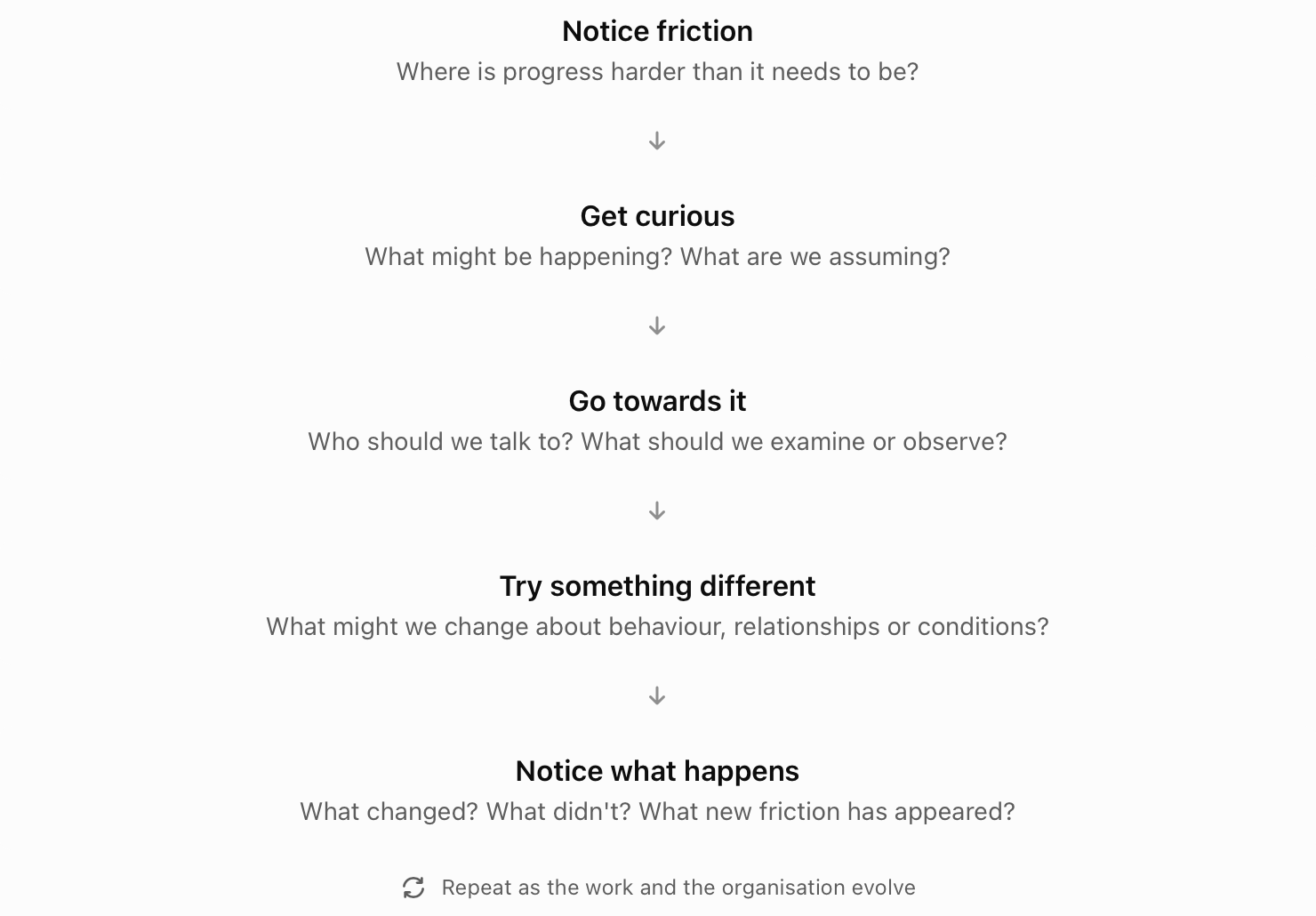
Over time this becomes common practice in your organisation
Why start with the executive team?
Much of the friction in an organisation is experienced by people who have limited power to do anything about it. Unproductive meetings, processes that make simple things complicated, tensions between teams, or unwritten rules about who can speak honestly and who needs to be more careful.
A conventional response might be to help those people develop the skills, confidence and awareness to deal with these challenges themselves. And that can be useful. But it can only get us so far.
Imagine you're regularly invited to a meeting that achieves very little. You know it's a waste of your time, and so does everyone else who attends. But the meeting is called by a member of the executive team. What happens if you stop turning up? Even if everyone agrees the meeting is pointless, who's going to tell the executive who runs it?
The problem isn't necessarily a lack of confidence or skill. It might be that the people with the power to change things don't realise there's a problem.
That's why we start with the executive team. Not because they're responsible for every difficulty in the organisation, but because they have the greatest influence over the conditions in which everyone else works. Their decisions, priorities, habits and even their most subtle behaviours can make change easier or harder, often without them realising it.
And unless they're willing to look at those things themselves, there's only so much people further down the organisation can do.
What the Friction Diagnostic isn't
It isn't an employee engagement survey, a measure of organisational readiness for change or a scorecard of executive team performance.
It doesn't establish the root causes of friction, identify who is to blame or produce a predetermined set of recommendations.
And it isn't an exercise where external consultants diagnose the organisation and hand the executive team a list of solutions.
It is a starting point for enquiry, not the conclusion of it.
The longer-term purpose
The friction an organisation experiences today may be quite different from the friction it encounters six months from now.
The aim isn't simply to identify and remove the obstacles revealed by the questionnaire. It's to help the executive team develop the habit of noticing friction, getting curious about what's causing it, going towards difficult issues rather than working around them, and experimenting with different approaches.
Over time, this becomes part of how the team leads the organisation through change.
The diagnostic helps leaders see where to start. The real value comes from developing their ability to recognise and address friction as it arises.
***
If you want to discuss this approach and how it might work in your organisation drop me a line blaire@thatpeoplething.com and we’ll get a meeting in the diary.
